Charles Frederick Worth and the fashion house he founded are enjoying something of a revival 200 years after his birth.
His creations are what we imagine whirling around ballrooms when we think of the Gilded Age. Whether the ball was held in Paris, London, or New York, you could be sure to see at least a handful of his designs gracing the dance floor. The women he clothed were among the highest ranks of Belle Epoque society, including empresses, princesses, and countesses, all of whom helped Worth earn the title, “the father of Haute Couture.”
/01/plum-velvet-gown-1901-cropped-662x1024.jpg)
Although many designers have gained fame in the 200 years since the birth of Charles Frederick Worth, he can arguably be called the first real fashion designer. What set Worth apart from his contemporaries was his deep understanding and use of fabric and trim. The quality of a Worth gown was like no other, and he set the stage for other designers to follow.
It was no doubt his youthful experience as a draper’s assistant that introduced him to the vast array of fabric choices available for dress construction. His father had abandoned the family, leaving them penniless due to years of dissipation and gambling debts. So, Worth’s mother sent young Charles, at the tender age of 11, to work at a print shop to help support the family.
Hating the job, and longing for a position in London where he didn’t have to get his hands dirty with ink, an acquaintance managed to secure a job for him at a department store: Swan & Edgar in Piccadilly. An 1889 article in the French newspaper, Le Figaro, summed up his youthful experience best:
/01/charles_frederick_worth_aged_14.jpg)
“At the age of 12, he left Bourne to go and work in London. During the seven years he spent there, his love of fine fabrics and his gift for arranging ladies’ outfits gradually emerged…. His greatest pleasure lay in helping to empty the packing cases of gowns, mantles, and hats that would arrive from Paris. Slowly he became emboldened to venture a few suggestions as to the arrangement of accessories, the alterations that might best be made to the Paris models in order to adapt them to English tastes, and so pertinent were his remarks that in time he came to be viewed as something of an authority.” 1
He soon set his sights across the Channel. In 1846, aged 21, with only 5 pounds in his pocket and unable to speak a word of French, he arrived in Paris. He got a job as an assistant at the draper Gagelin-Opigez, quickly learned the language, and his career took off.
Before the days of ready-to-wear, women wanting a new gown would choose a dress style they liked by perusing the illustrated plates in fashion magazines. They would then purchase their fabric of choice at a draper’s shop and take it, along with the magazine, to a seamstress to have it made up into a gown like the one illustrated.
Gagelin specialized in fine silks and cashmere shawls. Worth worked his way up from arranging the displays and promoting the sales of coats and mantles embellished with embroidery or lace, to becoming head sales assistant. Due to his excellent sales skills and knowing what would look best on a particular woman, he was eventually offered a partnership in the business. However, when Worth proposed that Gagelin expand their ready-to-wear line of clothing, which consisted at that time mainly of capes and mantles, they were reluctant to do so.
Frustrated by the restrictions his partners placed on him, Worth decided to venture into business on his own, partnering with the Swede, Otto Bobergh, who provided the bulk of the capital needed to start a drapers’ business. The 1860s were a booming time for Worth and Bobergh, largely due to a daring stunt by Worth’s wife, Marie Vernet, his preeminent model and staunchest supporter, whom he had met while working at Gagelin-Opigez.
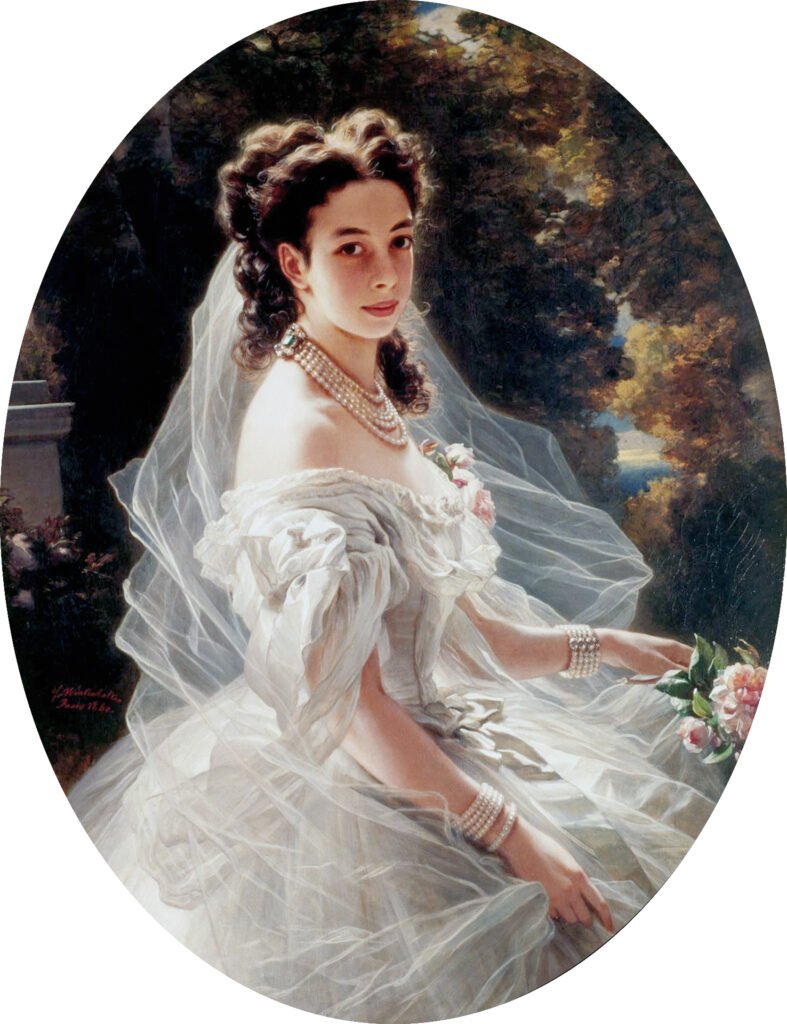
Fr Winterhalter / Paris 1860.
Knowing the influence that Princess Pauline von Metternich had on members of the French Imperial court, Marie decided to approach the princess with one of her husband’s sketchbooks.
She gave the sketchbook to one of the princess’s maids, and although von Metternich at first refused to even entertain the shocking idea of being dressed by an Englishman, once she was persuaded to look at the sketches in the book, she found every one “charming and ravishing” and told her maid to show Marie in.
Marie told the Princess that her husband’s earnest wish was to create a gown for her and to name the price she wanted to pay for it. Pauline ordered two dresses for a total of 600 francs (approximately $7,740 today), and after one week and only a single fitting, the gowns were delivered to her.
The princess wore one of them to a ball at the Tuileries the following week. It featured silver spangles, pink-centered daisies with sprays of wild grasses, and was veiled in white tulle. Around her waist she wore a wide white satin sash studded with diamonds.
As soon as the Empress Eugénie saw it, she had to know who the princess’s dressmaker was and asked Pauline to send him to her the next morning at ten o’clock.2
From that day on, Worth had no shortage of clients, with every lady at court wanting to emulate the Empress’s style. Needless to say, Pauline von Metternich would never pay only 300 francs for a Worth gown again.
The 12-year contract that Worth had made with Bobergh, stating that their partnership was a “joint company to sell silks, lace, cashmere, and furs and to make ladies’ dresses and mantles,” began on July 1, 1858. Interestingly, it expired right on the eve of the outbreak of the Franco-Prussian war and the siege of Paris. Doubting the future of high fashion in post-Imperial France, Bobergh decided not to renew their contract and returned to Sweden, giving Worth the freedom to develop the business and design gowns as he saw fit.
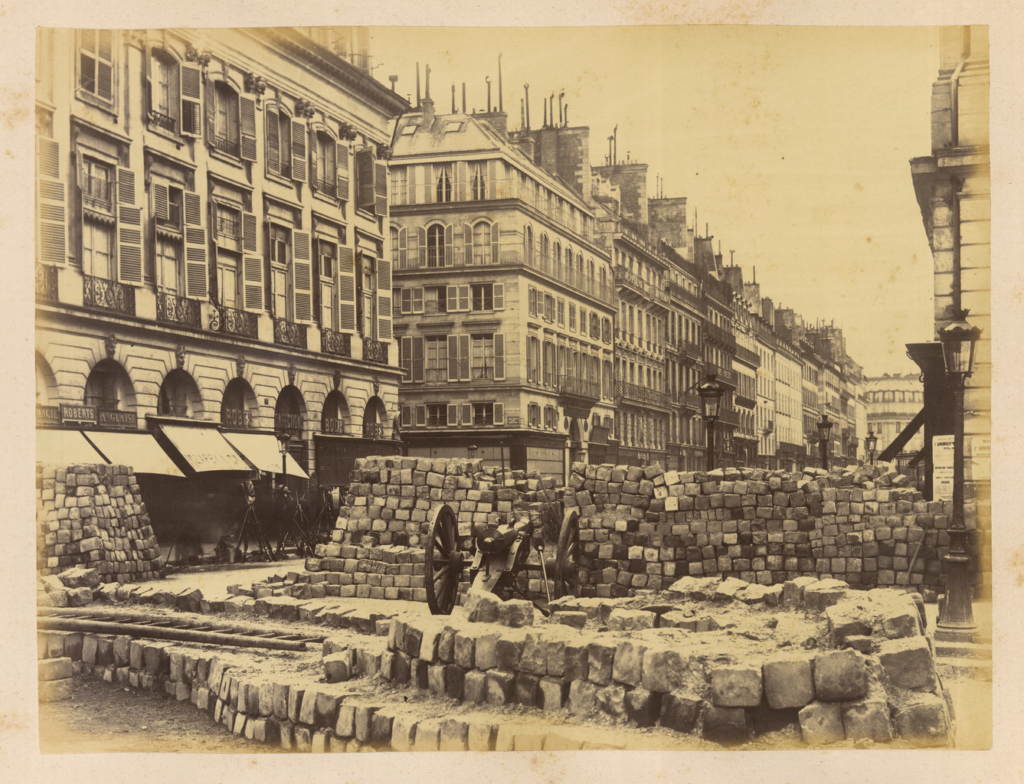
During the Franco-Prussian war, which lasted less than a year, Worth briefly closed his doors and transformed the salons at 7 rue de la Paix into a hospital to treat the many injuries sustained by French troops. He and his family did what they could to help tend the wounded until the siege was over and the Commune had been declared, in March 1871. During the Commune, the Worths briefly fled to Le Havre, but they returned to Paris in June, after its defeat by the French government. Although he had been dismayed at the exile of his best clients (and indeed, friends), the Empress Eugenie and Princess von Metternich, his remaining wealthy clients lost no time in returning, despite the fact that they had to climb over barricades and rubble to get there.
Worth’s fancy dress costumes and the Vanderbilt Ball
Worth’s personal passion for fancy dress was perfectly expressed in the many outfits he made for the numerous fancy dress balls held in the late 19th century. His youthful days spent in the National Gallery taking in their Old Master paintings had a major influence on how he clothed his clients for their big events. He made detailed notes on the dress and accessories worn by the paintings’ subjects, in particular the often elaborate fabrics.
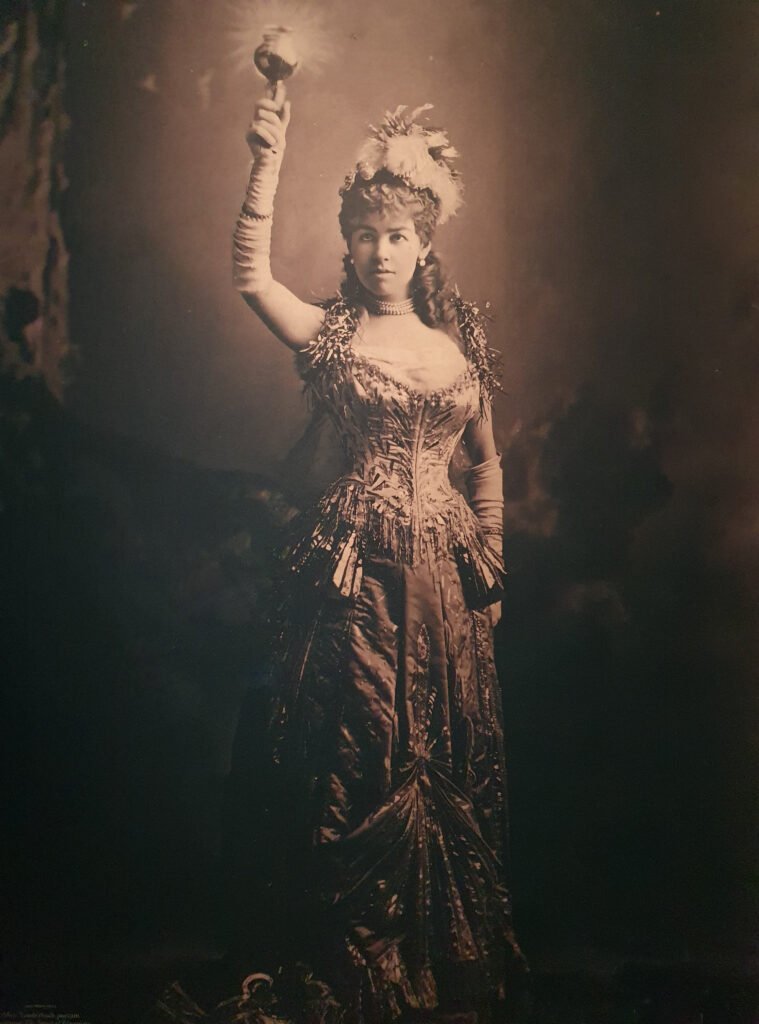
Among his most famous fancy-dress gowns was the one he made for Alice Vanderbilt for the notorious costume ball held by her sister-in-law, Alva, and her husband William K. Vanderbilt, in their new mansion on Fifth Avenue in New York in March of 1883.
Alice went dressed as “Electric Light,” Thomas Edison having just “electrified” New York the previous autumn. There is an urban legend that the torch she carried with her lit up, powered by batteries concealed beneath her dress. However, this is highly unlikely, according to Elizabeth Randolph, the Collections Manager for Costumes and Textiles at the Museum of the City of New York, where the dress currently resides.3
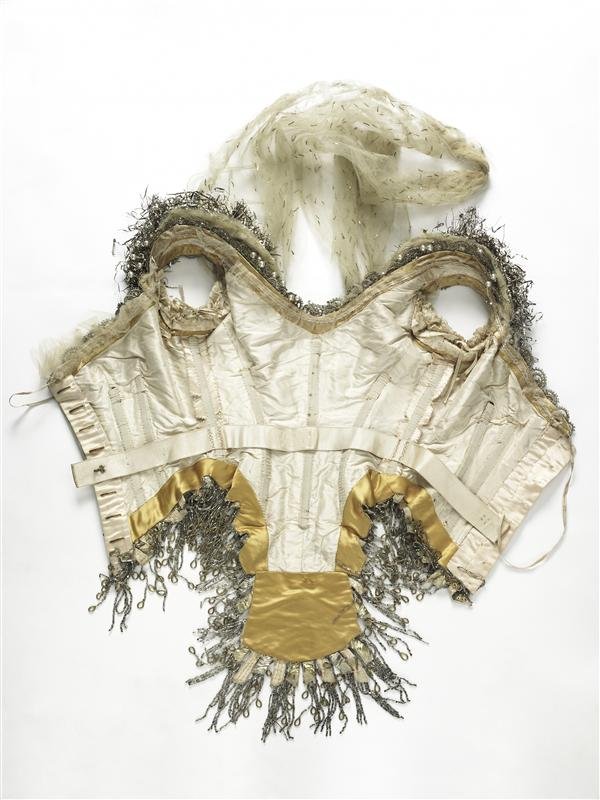
Not only would it not have been possible to hide a battery in her closely fitted bodice, there would also have had to be a large cable running down her arm to the torch. The glow from the torch in the Mora photograph is clearly a retouching job. No matter, the gown was a sensation and helped gain the Vanderbilts entrée into Mrs. Astor’s famous “400”.
Over an underskirt of midnight blue velvet, Worth had laid gold satin embroidered with metal filaments in lightning bolt and starburst motifs, which would have glowed and glittered under the lights. Silk was also used for both the lining of the bodice and the casings holding the boning, with hand-stitched finishes.
The lightning bolts consisted of gilt sequins and tonal metallic beadwork, and the fringe was made from tiny, clear, mercury-lined short beads and spring-coiled flat tinsel. The bodice closes at the center front, by buttons concealed under a placket. The gold satin shoes, saffron-colored sequined stockings, headpiece, and wig that Alice wore on that evening still exist in the collection of the Museum of the City of New York. 4
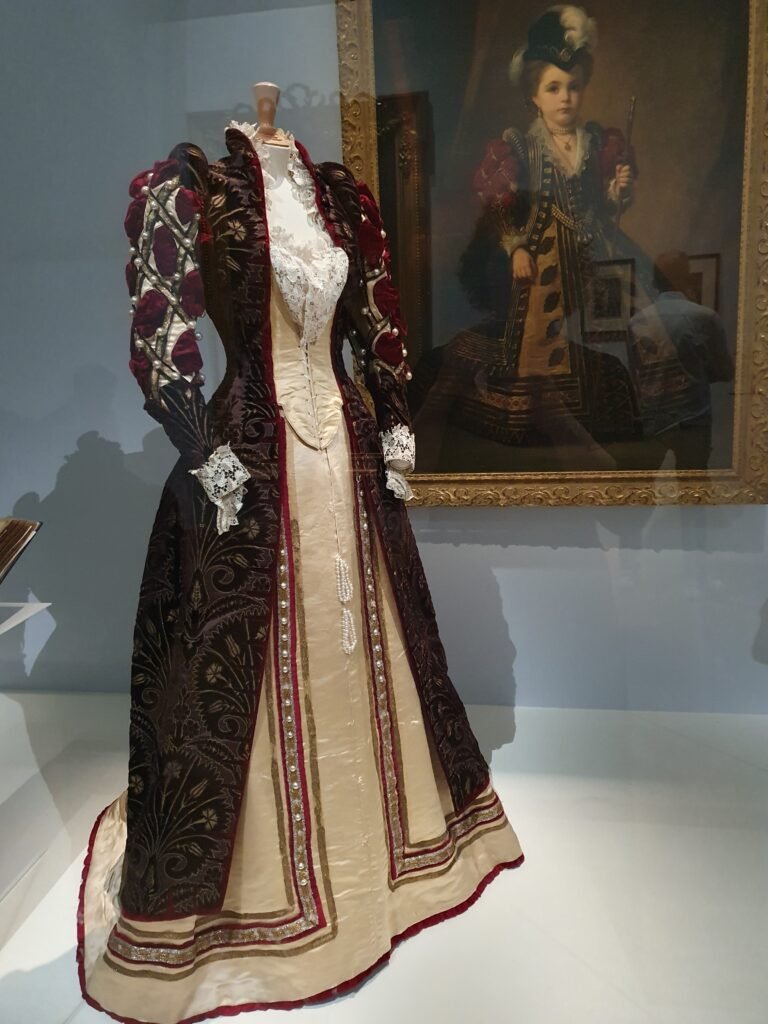
Jean-Phillipe Worth inherited his father’s love of creating costumes for fancy balls, as evidenced by this Elizabethan-style costume (right) that he made for Madame Pécoul to wear to a ball held by Princess Sagan in 1893. The painting on the wall behind it by Charles-Loius Müller had been commissioned by Charles Frederick Worth in 1859 in homage to the master painters he had admired in the British Museum as a youth. It is of little Jean-Philippe at age 3, reminiscent of a 17th century Spanish infanta painting by Velázquez.
In 1895, Charles Frederick Worth caught a virus during a wet, chilly trip to the theatre with his grandchildren, and the infection soon spread to his lungs. He died of pneumonia at his apartment in Paris on the 10th of March, at the age of 70.
While his son, Gaston, handled most of the business end of things at the House of Worth, Jean-Philippe became the chief designer. He carried on his father’s tradition in terms of creating gowns with stunning embellishments, while reducing the enormous amounts of fabric his father had used in favor of creating a sleeker, more fluid line that complemented the female figure.
The “princess line,” created by Worth in the 1870s and named for Britain’s Princess Alexandra, had no horizontal waist seam. It instead employed vertical seams dropping from the shoulder and underarm, which had the effect of lengthening the body and emphasizing a woman’s natural curves.
Some of the greatest examples of these gowns can be seen in the dresses the House of Worth created for Countess Greffulhe, Franca Florio, and Lady Curzon.
Countess Greffulhe
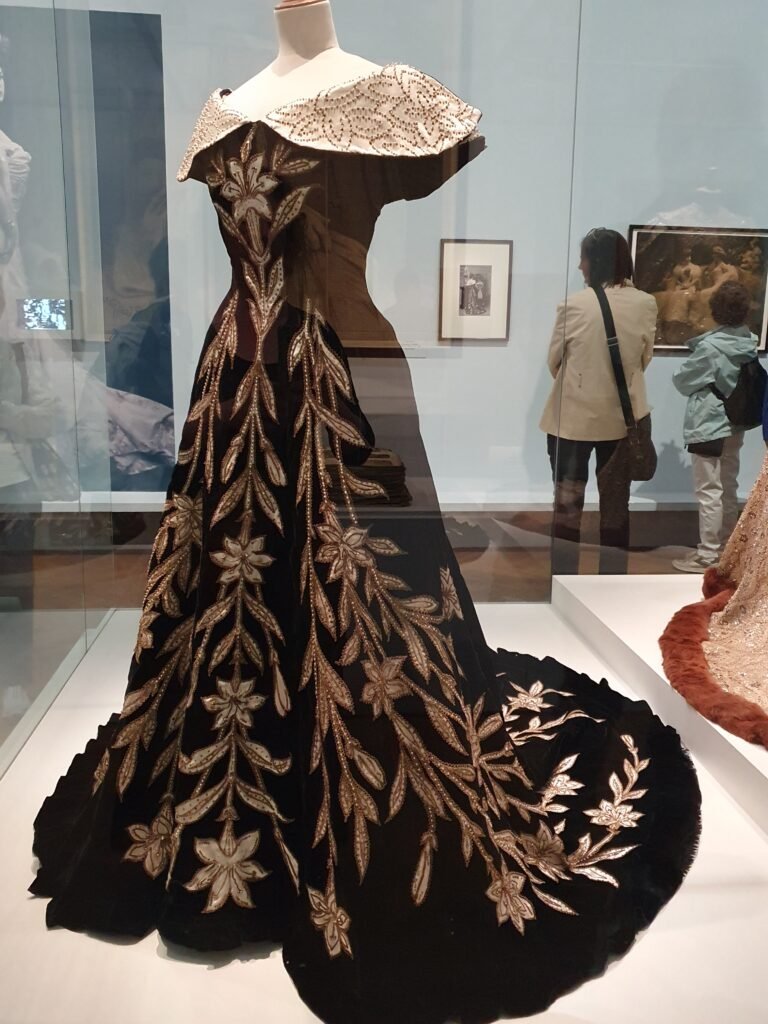
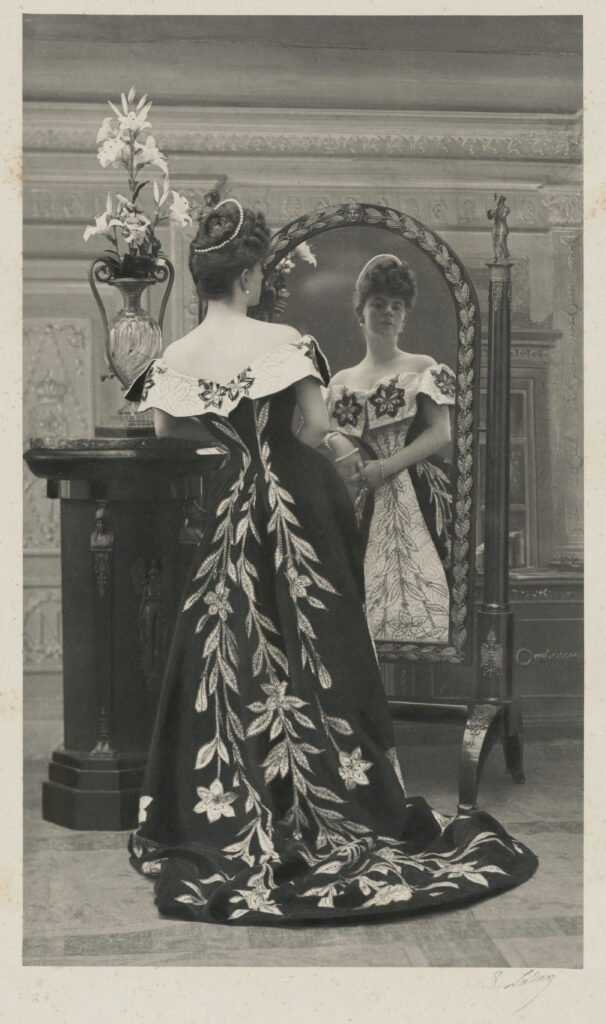
The Lily gown that Jean-Philippe Worth created for Countess Greffulhe in 1896 was photographed by the Countess’s friend, Paul Nadar, at her request. She appears to be getting ready for an evening out, clothed in the gown and gazing at us from her reflection in the mirror. Interesting to note is that the original gown as shown in the photo is not exactly like the gown in its current state. The embroidered collar and front panel were removed to update it for the early 1900s, and the wide bertha collar is a reconstruction from the 1960s.5
The Duchess was said to have a strong, eccentric personality and reportedly had a hand in creating many of the outfits she wore. The press of the time said she would far rather be considered “bizarre” than “banal”. Marcel Proust used her as the model for the character of the Duchesse de Guermantes in his novel, Remembrance of Things Past. He wrote of her character, “Each of her gowns seemed to me her natural, necessary surroundings, like the projection around her of a particular aspect of her soul.”6
Franca Florio
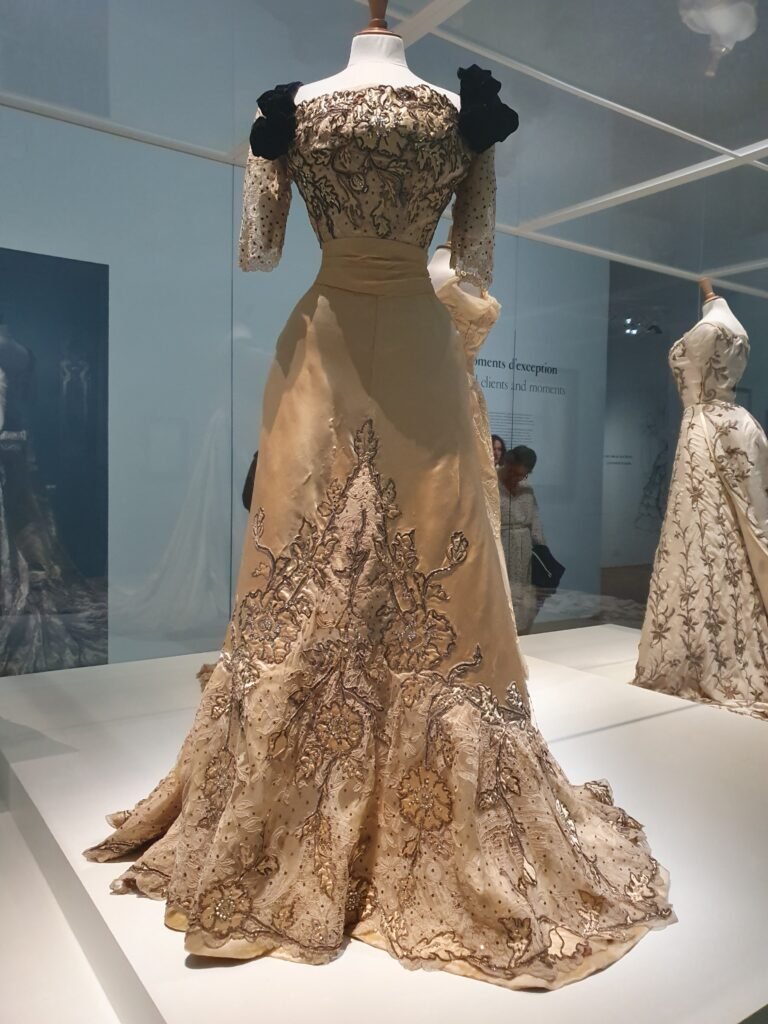
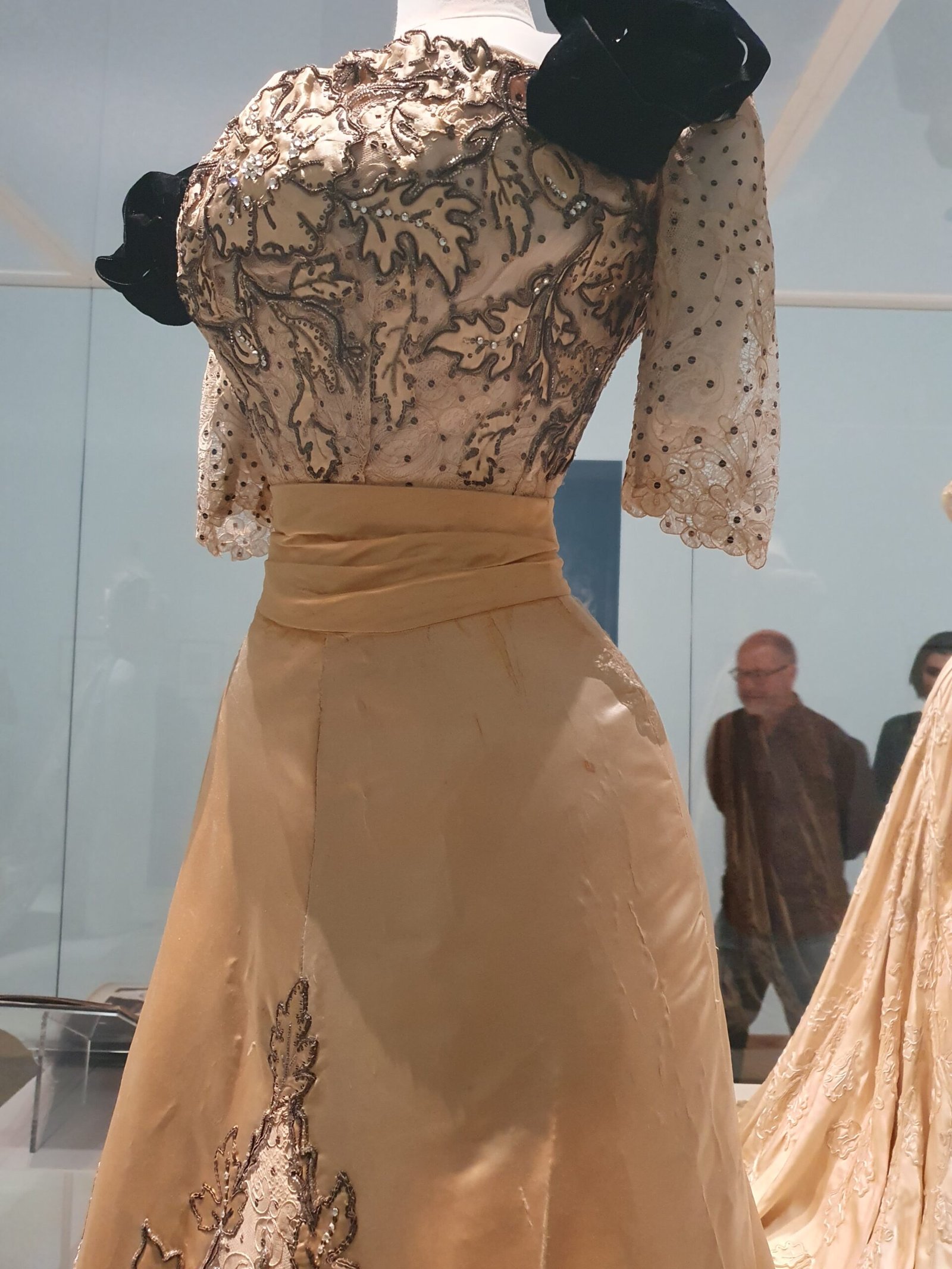
Jean-Philippe Worth called Franca Florio “the best dressed and most beautiful woman in Italy.” An Italian noblewoman nicknamed “the Queen of Palermo,” Franca Florio was the opposite of the “dollar princesses” common in America. She was the one with the title, her husband the one with the money.
In some cases, Jean-Philippe believed in the “less is more” philosophy. He wrote of Franca Florio, “I recall her wearing a quite plain white dress of stamped velvet at the christening of an imperial prince, where all the other ladies in waiting appeared in gowns ornately embroidered. The very simplicity and beauty of line of her dress contrived to cheapen the others and make them seem fussy.”7
Worth made the “Oak Leaf” dress (above) for her of yellow silk satin and black silk velvet. According to fashion historian Alessandro Massetti, this gown had to undergo considerable restoration at the Palazzo Pitti in Florence, as it had been kept in less than ideal conditions, and over time, much of the silk had torn or disintegrated due to the salts that had been used when processing the original yarn.8
Luckily for us, conservators managed to stabilize the fabric enough for it to be displayed at the recent Worth exhibition in Paris. Just look at the incredible detail in the train, a combination of yellow silk satin appliqué, ivory lace, metallic thread, embroidery, sequins, rhinestones, and pearls.
Lady Curzon
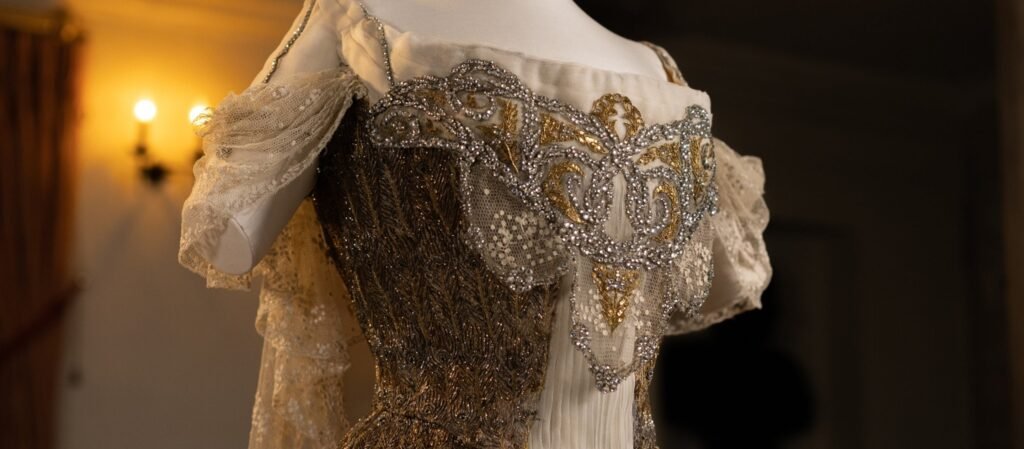
The American socialite, Mary Victoria Leiter, married Lord Curzon in 1895, among other of the “dollar princesses” of that time who helped save Britain’s landed estates from falling into ruin with their abundant dowries, while inheriting aristocratic titles. Although begun as a financial arrangement, their marriage flourished, and when Mary died aged only 36, Lord Curzon was devastated.
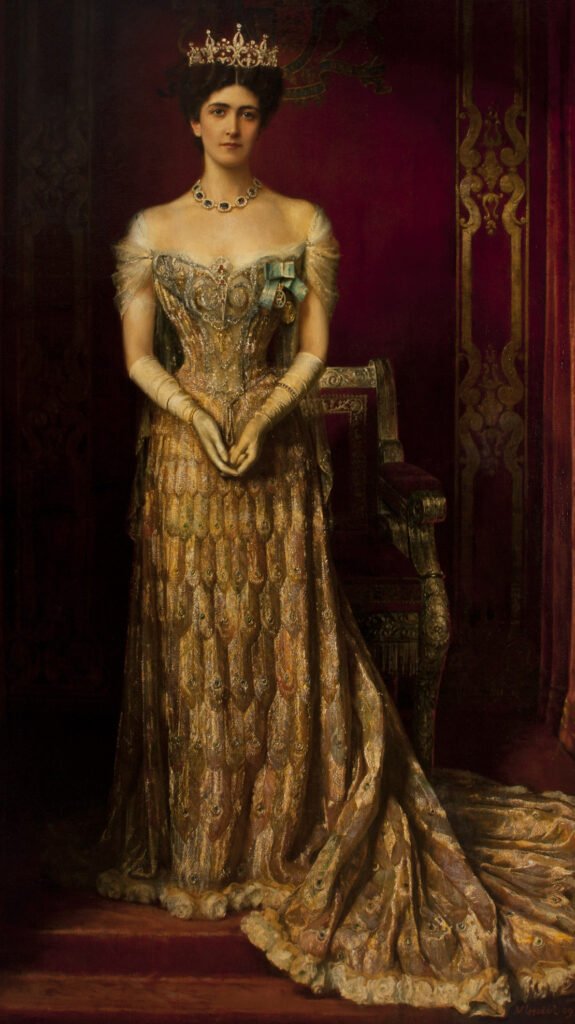
Worth made a few gowns for Lady Curzon that were made in two stages. Indian embroiderers were employed to hand-sew metallic thread, sequins, and crystals onto the gown’s panels of silk taffeta with a cotton muslin backing, using a technique called “zardozi”. Zardozi originated in Persia, and comes from the words “Zar”, meaning “gold,” and “dozi”, meaning “embroidery.” The embroidered panels were then sent to Paris where they were assembled by the seamstresses at Worth, with the finished gown then returned to Lady Curzon in India. This was the case for both the court dress that was made after her husband was appointed Viceroy of India and for the famous “Peacock dress” that she wore for the Delhi Durbar ball, celebrating the coronation of King Edward VII and Queen Alexandra as Emperor and Empress of India. In addition to the ornate embroidery, it featured green beetle wing cases resembling emeralds, silk lace netting and rhinestones at the neckline and over the bodice, and white silk roses at the hem. Although it has been on display at the Curzon’s estate at Kedleston Hall in Derbyshire, it is currently undergoing conservation and will not be displayed to the public again until 2027.
Were Worth gowns “worth” their price?
According to Jean-Philippe Worth, J.P. Morgan came to the atelier with his wife in 1910 to purchase a gown for her. Worth wrote, “There was never anything too beautiful or too good for J.P. Morgan.” One particular gown “caught his fancy” and insisted his wife have it, despite her objection at its price. It cost 8000 francs in 1910, which was the equivalent of over 23,000 dollars today. Mrs. Morgan apparently wore it only once.9
Yet, it was not the cost of a Worth gown that made it special. What distinguishes Worth’s creations from many of the other fashion houses of his time are the care with which he chose (and in many cases had manufactured) the fabrics used, as well as the spectacular embellishments added to each gown. Worth worked closely with silk cloth manufacturers in Lyon and frequently had them produce bolts of fabric designed to order.
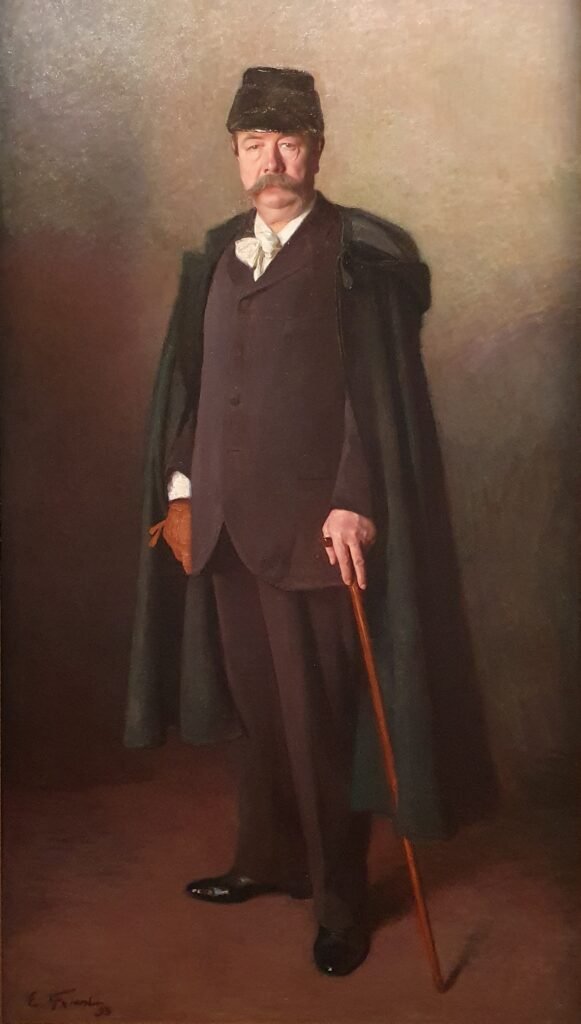
In my opinion, his earlier designs made women look less like elegant flowers than items of upholstered furniture. However, his ability to combine a variety of silks, brocades, velvets, and damasks, along with their associated trimmings, so as to create the most dazzling effects was unrivaled.
Interestingly, the interiors of the gown are less finished that one might expect. High-end clothing today would never be devoid of a bagged lining, for example. Happily for those interested in fashion history, we can “look behind the curtain.” If you examine the inside of a Worth bodice, you can see all the seams and boning. We can also admire the quality of the hand-sewn finishes, such as the silk boning casings and the whip-stitched seam allowances.
After passing on to a third generation of the family, the House of Worth finally closed its doors in 1956. Yet Charles Frederick Worth left his mark indelibly on the fashion industry. He truly was the father of Haute Couture.
1 “Souvenirs d’un grand couturier,” Le Figaro, 13 April 1889, pp. 58-59.
2 Trubert-Tollu, C., et al. (2017). The House of Worth: The Birth of Haute Couture, 1858-1954 (pp. 33-34). Thames & Hudson.
3 Raymond, Carl (Host). (2024, May 28). The Gilded Age’s Most Famous Dress (Episode 82). [Audio podcast episode]. In The Gilded Gentleman. https://thegildedgentleman.com/episodes/gilded-age-most-famous-dress/
4 Raymond, C. [@carlthegildedgentleman]. (2024, May 26). “The Gilded Age’s Most Famous Dress: Alice Vanderbilt’s ‘Electric Light’” In addition to the original dress itself, Alice’s accessories exist… [Photograph]. Instagram. https://www.instagram.com/p/C7bzemJOTFy/
5 Trubert-Tollu, C., et al. (2017). The House of Worth: The Birth of Haute Couture, 1858-1954 (p. 188). Thames & Hudson.
6 Proust, M. (1925). Remembrance of Things Past (C. K. Scott Moncrieff, Trans.). Random House.
7 Worth, J.-P. (1928). A Century of Fashion (p. 209). Boston : Little, Brown, and Co.
8 Masetti, A. (2014, June 25). Exhibition – The court cape of Lady Franca Florio. The Fashion Commentator. https://www.thefashioncommentator.com/2014/06/mostra-donna-franca-florio-firenze.html
9 Worth, J.-P. (1928). A Century of Fashion (p. 224). Boston : Little, Brown, and Co.


Leave a Reply